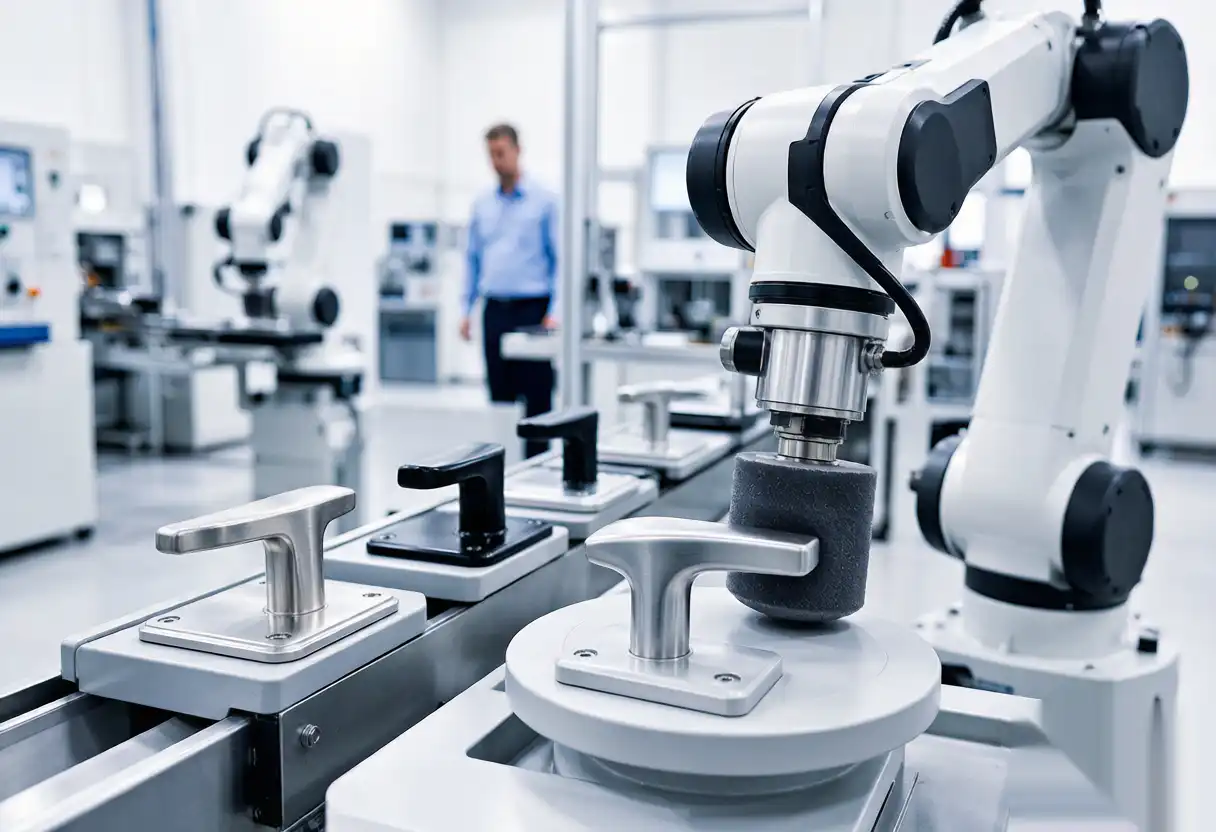


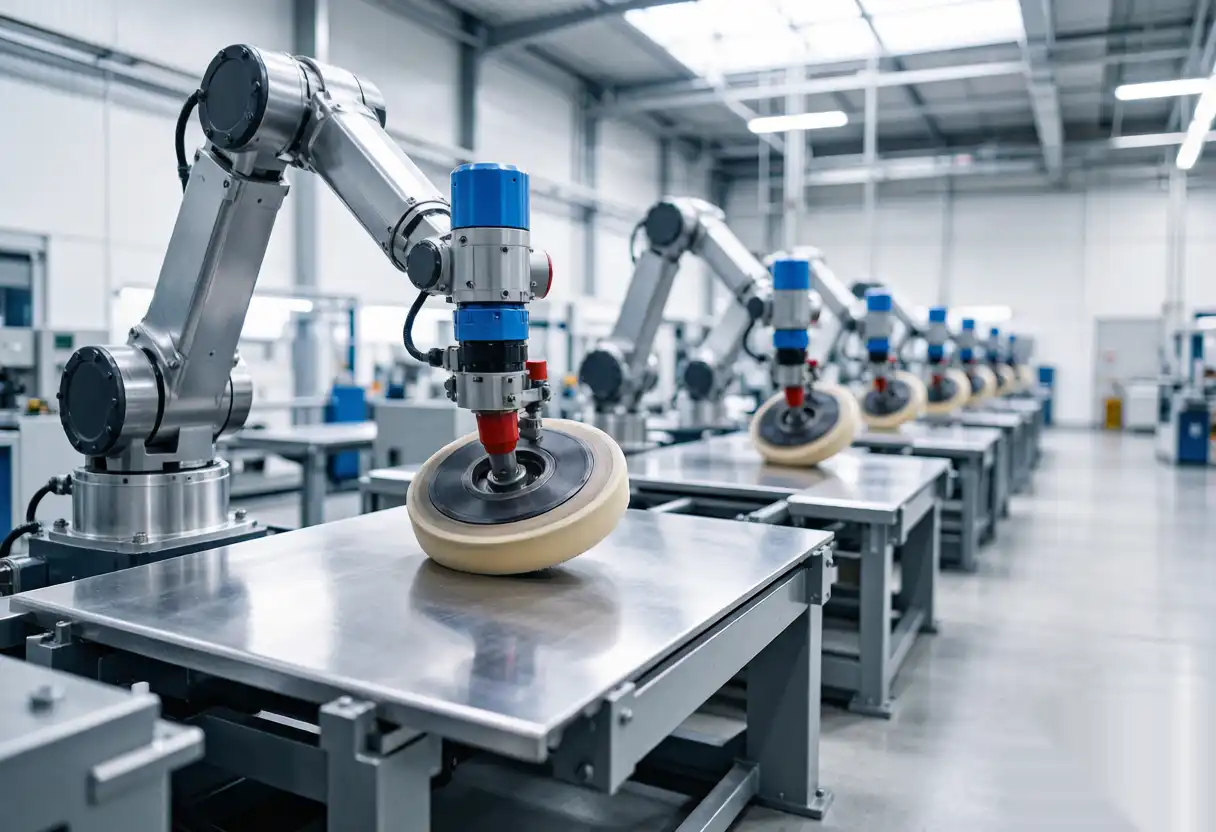
A robotic buffing machine is a force-controlled industrial robot fitted with a rotating buffing wheel or buffing wheel spindle that applies abrasive compound to a metal part to build the final high-gloss shine. Where a manual operator leans into the work with variable pressure and a tired wrist, an automated buffing system holds a programmed normal force, a fixed wheel speed, and a metered compound dose on every single pass. For metal finishing operations that ship faucets, hardware, door fittings, and decorative trim, this single change removes the most unpredictable step in the whole process and turns a craft skill into a repeatable recipe. The same force-control philosophy that drives modern robotic polishing machines for metal parts applies just as strongly at the buffing stage, where consistency is everything the customer can see.
Why Buffing Is the Bottleneck Manual Shops Never See
Most finishing managers can describe their grinding and polishing rates precisely, but they estimate buffing output by feel. That blind spot is expensive. Buffing is where the part earns its mirror look, and it is also where human inconsistency is most visible: a slightly heavier hand on one side leaves a dark band, a moment of distraction misses a fillet, and a tired operator drifts off the recipe by the final shift. A buffing robot for metal removes that variability because the cell does not get tired, does not have a bad day, and does not interpret the finish differently from one part to the next.
The second reason buffing hides cost is labor intensity. Manual buffing is dusty, repetitive, and physically demanding, which makes it hard to staff and harder to keep staffed at consistent quality. An automated buffing system lets one operator supervise three or four cells instead of running one wheel, and it makes lights-out running practical because there is no hand to hold the part or judge the gloss.
Advantage 1: Surface Gloss Uniformity That Manual Work Cannot Match
The headline benefit of a robotic buffing machine is uniform gloss across every part and every batch. Gloss is built by how the wheel compresses the compound into the surface and shears the micro-burrs flat, and that depends almost entirely on consistent normal force. A human holds somewhere between 20 N and 80 N depending on posture, fatigue, and the shape being worked; a force-controlled buffing robot holds its setpoint within about plus or minus 2 N across the whole program. The result is a measured gloss variation that drops from a typical 15 to 25 gloss units on manual work down to 3 to 5 gloss units on a well-tuned cell.
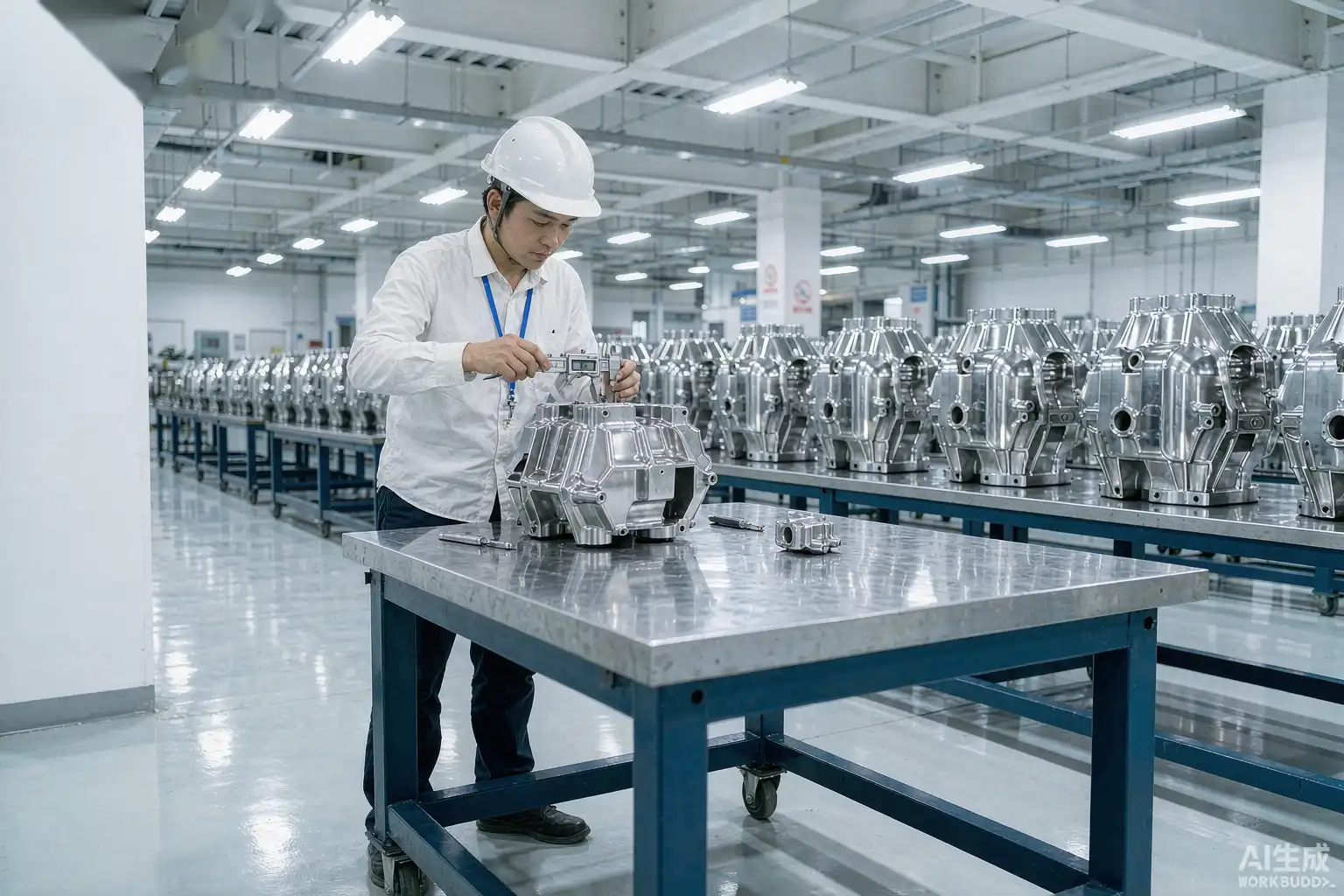
This matters most on parts viewed closely by end users, such as faucet bodies, towel bars, and cabinet hardware, where a faint streak reads as a defect even when the Ra value is acceptable. By locking force, dwell, and wheel speed, the cell produces a mirror buffing machine result that passes visual inspection on the first look instead of after a rework loop.
Advantage 2: Dramatic Labor Savings and Lights-Out Running
A manual buffing line typically pairs one skilled finisher with one wheel and produces a fixed number of parts per shift regardless of demand. A robotic buffing cell flips that ratio: one operator tends a battery of cells, loads fixtures, and handles quality checks, while the robots run continuously. In real installations on faucet and hardware lines, labor per finished part drops by 60 to 80 percent, and the freed operators move to higher-value work such as fixture design, first-article inspection, and cell tending.
Lights-out running is the multiplier. Because the process is stored as a program rather than carried in a person’s hands, the cell can run a second and third shift with only periodic supervision. A shop running a 6-axis buffing robot for two shifts instead of one often recovers the equipment cost faster than the quoted payback simply by using the asset more hours per day.
Advantage 3: A Repeatable, Stored Recipe for Every Finish
The third advantage is the recipe itself. A robotic buffing cell stores the full process as digital parameters: normal force in newtons, wheel speed in RPM, compound dose in grams per cycle, pass count, and toolpath. That means a new operator can reproduce a senior finisher’s result on day one, and it means a finish qualified six months ago can be re-run today with the same numbers. This repeatability is the foundation of statistical quality control, and it is closely related to the consistency gains described in our guide on how robotic polishing improves consistency in metal finishing.
Storing the recipe also makes continuous improvement visible. When an engineer trims cycle time or tunes compound dose, the change is logged against the part number, so the shop builds a library of optimized processes instead of relying on tribal knowledge that walks out the door at retirement.
Advantage 4: Consistent Compound Application and Lower Consumable Waste
Manual buffing wastes compound constantly. Operators over-apply to be safe, let the wheel load unevenly, and discard wheels that still have life because they are clogged. A buffing robot for metal meters compound by cycle count and wheel-wear state, typically applying 1.5 to 4 grams of bar or liquid compound per part depending on size. That tight control cuts compound consumption by 20 to 40 percent versus hand work and keeps the wheel cutting cleanly instead of glazing.
Lower waste also means a cleaner surface and fewer rejects. Over-application is the leading cause of streaky, hazy finishes, so metering the compound is not just a cost play; it is a quality play.
Advantage 5: A Safer Cell and Cleaner Air
Buffing generates fine abrasive and metal dust, and the wheel throws it in an arc around the operator. Enclosing the automated buffing system and connecting it to a dedicated extraction loop protects the worker and keeps the dust off adjacent grinding and inspection stations. For plants chasing ISO 9001 discipline on a clean finishing floor, the enclosed robotic cell is materially easier to document and audit than an open manual bench.
How a Force-Controlled Buffing Cell Actually Works
A typical metal buffing automation cell pairs a 6-axis robot with a servo buffing spindle mounted either on the robot wrist or on a fixed pedestal. The part is held in a fixture on a rotary positioner so the robot can reach all faces without re-clamping. The controller runs a toolpath generated from the part CAD, and a force-torque sensor at the wrist adjusts the contact force in real time as the wheel wears down or the surface rises and falls. Wheel speed is held in a band appropriate to the compound, often 1,500 to 4,000 RPM for cotton or sisal buffs, while the robot feed rate is tuned so the wheel never stalls or burns the part.
Compound is delivered by an automatic applicator that contacts the spinning wheel between parts, so each cycle starts with a fresh, correctly loaded face. After cut buffing, many cells switch to a softer color buff and a finer compound to close the surface to a true mirror, a sequence we detail in our article on key technologies behind automatic buffing machines.
Parameters That Define a Good Buffing Cell
The numbers below are representative of production cells running decorative brass, stainless, and zinc hardware. They are starting points for a feasibility study, not a final specification, and should be confirmed against your own parts.
| Parameter | Manual buffing | Robotic buffing cell |
|---|---|---|
| Normal contact force | 20–80 N (variable) | 30–60 N (plus or minus 2 N) |
| Buffing wheel speed | 1,200–3,500 RPM | 1,500–4,000 RPM |
| Gloss variation | 15–25 gloss units | 3–5 gloss units |
| Compound dose | By eye, 30–50 percent waste | 1.5–4 g per part, metered |
| Cycle time per part | 60–150 s | 45–90 s |
| Labor per part | 1 operator per wheel | 1 operator per 3–4 cells |
| Attainable Ra after buff | 0.05–0.2 µm | 0.02–0.1 µm |
| Rework rate | 5–12 percent | 1–3 percent |
Where Robotic Buffing Pays Off Fast
The clearest wins are high-volume, high-visibility parts where gloss consistency drives the sale. Faucet bodies, shower components, door handles, and decorative trim all reward a uniform mirror. A robotic buffing cell also pays back quickly when the part is complex enough that manual buffing needs multiple operators per piece, or when labor cost and scrap together exceed the financing on the equipment. Across the metal finishing automation projects we see, a buffing robot for metal typically reaches payback in 12 to 18 months once it replaces two or more manual stations and runs beyond a single shift.
For shops already running faucet polishing automation with robotic buffing, adding a dedicated buffing cell downstream of the polish stage is often the single highest-return step because it converts a variable manual finish into a locked, salable spec.
Common Mistakes When Specifying a Buffing Robot
The first mistake is buying the robot before defining the finish. Gloss target, Ra target, and acceptable defect level must be written down and measurable before any cell is quoted, or the supplier cannot tune force, wheel, and compound to a number. The second mistake is under-sizing extraction; a buffing cell throws dust in a predictable arc, and the enclosure and dust collector must be specified for that load or the cell contaminates itself. The third mistake is treating buffing as isolated from polishing; if the polish stage leaves deep marks, no buffing robot can hide them, so the two stages must be specified together.
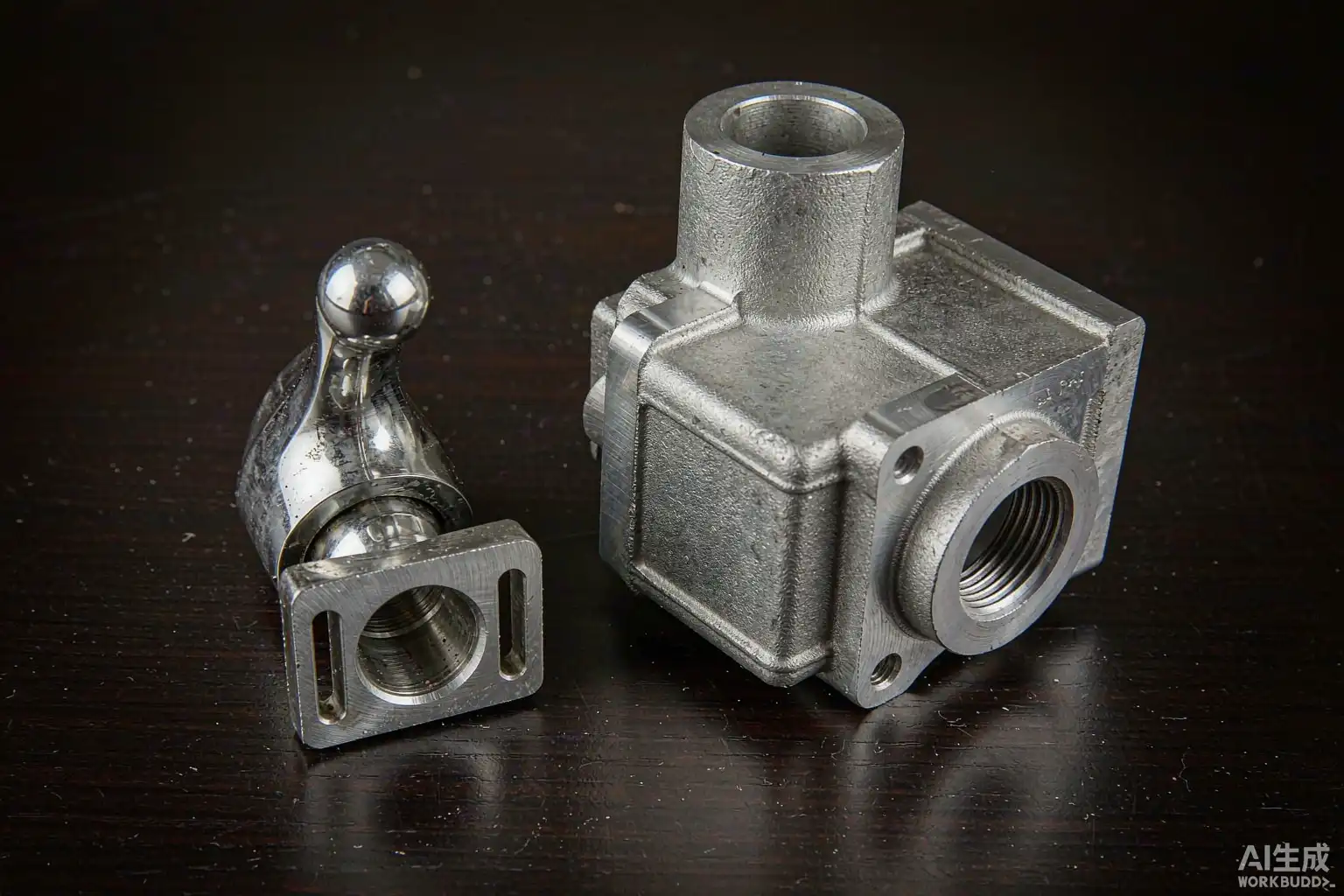
A fourth, quieter mistake is ignoring fixture design. A buffing robot is only as accurate as the positioner that presents the part, so invest in repeatable locating, especially for thin-wall or decorative castings that can flex under force.
Frequently Asked Questions
Is buffing the same as polishing?
They are related but distinct. Polishing cuts the surface to remove marks and lower Ra, while buffing is the final, softer-wheel stage that builds gloss with compound. A complete line usually does both.
What spindle speed should a buffing wheel run?
Cotton and sisal buffs normally run between 1,500 and 4,000 RPM, with the exact speed set by the compound and part size. Too fast burns soft alloys; too slow loads the wheel.
Can one cell do both cut and color buffing?
Yes. Most production cells use two wheels or an automatic tool change to run a cut buff with coarser compound followed by a color buff with finer compound, all inside one program.
How much labor can we actually save?
In typical faucet and hardware lines, labor per finished part drops 60 to 80 percent because one operator tends several cells and lights-out shifts become practical.
What Ra can a robotic buffing cell reach?
After a proper polish stage, a buffing cell commonly closes the surface to 0.02 to 0.1 µm Ra, which reads as a true mirror on decorative metal.
Need the Right Robotic Buffing Machine for Your Parts?
If you are weighing a robotic buffing machine for faucets, hardware, or decorative trim, the application engineers at Xiamen Dingzhu Intelligent Equipment can help you size the cell to your part geometry, daily volume, and target gloss. We routinely design force-controlled buffing robots for metal that pair with upstream polishing and deburring so the whole line holds a single, documented finish spec, and we can walk you through the compound and wheel progression that fits your alloy. To see how a dedicated buffing stage fits into a larger automated line, review our guide on key technologies behind automatic buffing machines, then bring us your castings, volumes, and finish targets for a concrete recommendation.
References
- Robotics Industries Association — https://www.robotics.org
- American Foundry Society — https://www.afsinc.org
- ISO 10218 (industrial robots) — https://www.iso.org
This article is for general guidance only and does not constitute a specification or quote. Confirm process parameters and tolerances with the equipment supplier for your specific parts.