

For decades, faucet manufacturing has been a fragmented process: castings arrive from the foundry, move to grinding stations, then to polishing, and finally to assembly — each step handled by separate teams with separate equipment. Material moves between buildings. Quality varies between shifts. Scrap accumulates at every handoff.
The question facing sanitary ware manufacturers today is simple but transformative: what if casting, deburring, grinding, and polishing could happen in a single, automated production line?
This article explores the design, technology, and ROI of an integrated automatic faucet production line that takes castings from raw metal to finished surface — without a single manual touch.
1. The Traditional Faucet Production Workflow
To understand the value of integration, we first need to map the conventional process. A typical faucet manufacturing plant operates with five physically separated stations:
- Casting & knockout — Raw brass or zinc alloy is die-cast, cooled, and gates are manually removed
- Rough grinding — Casting flash, parting lines, and sprue marks are ground down by hand (2–4 workers per shift)
- Deburring — Internal passages and threaded holes are cleaned of burrs, often with pneumatic tools
- Polishing & buffing — The visible surface is brought to a mirror finish through progressive grit stages (3–5 workers)
- Inspection & packaging — Final QC check, then packing for shipment or assembly
Between each station, parts are stacked, moved on carts, and re-inspected. The total throughput time from casting to finished surface can exceed 48 hours, with labor accounting for 30–40% of the total manufacturing cost.
2. The Integrated One-Line Concept
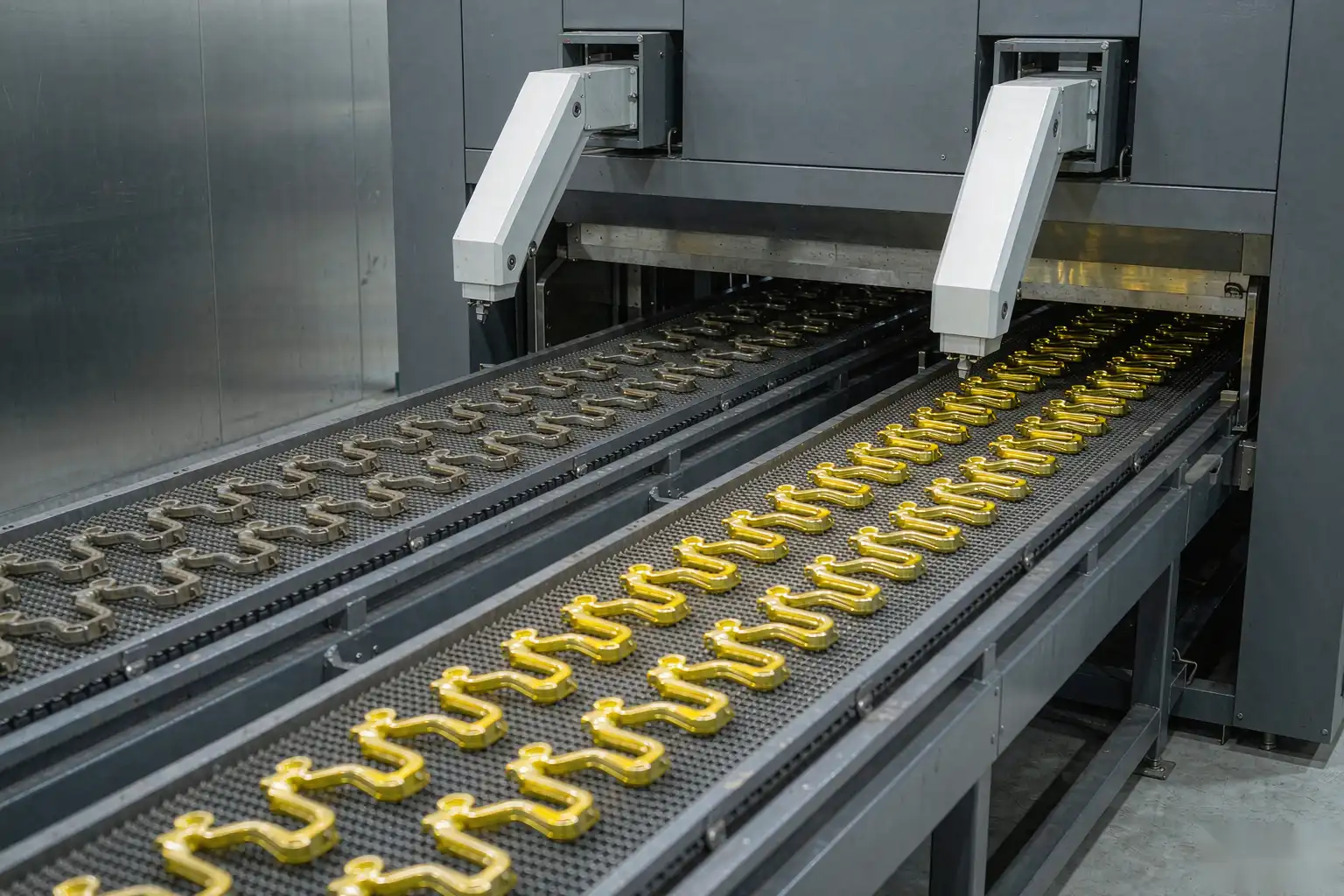
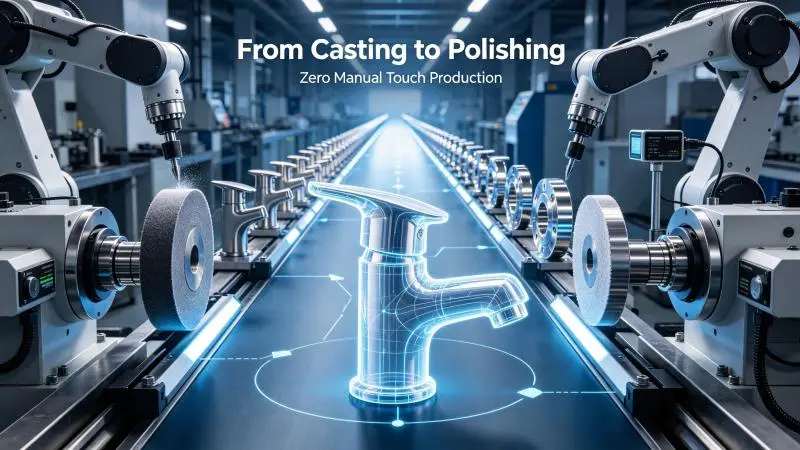
An automatic faucet production line consolidates all finishing operations into a single, conveyor-linked system. The core architecture includes:
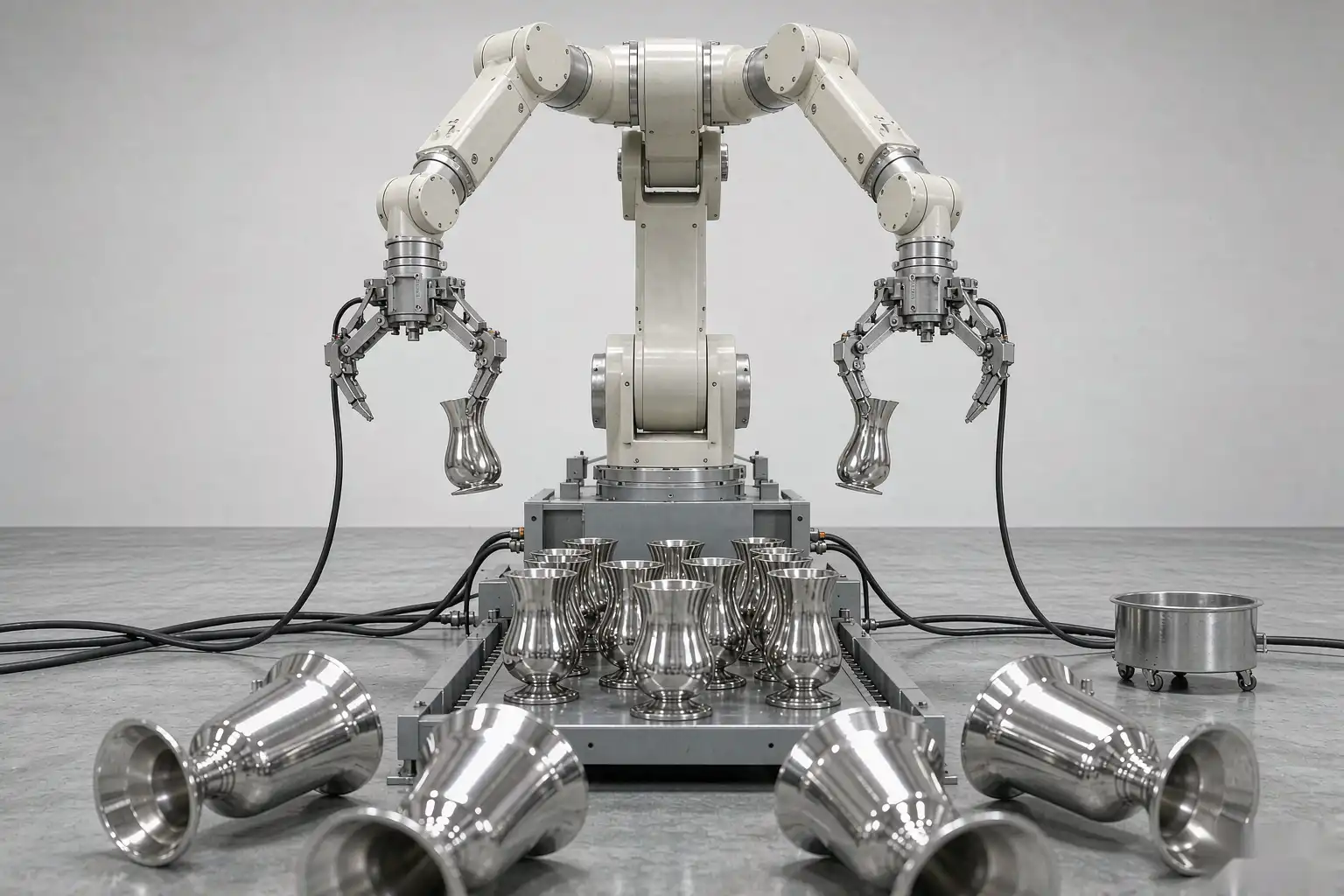
- Robotic loading station: Castings are placed on fixtures by a 6-axis robot or automated gantry, aligned to sub-millimeter precision
- Deburring module: Servo-driven deburring spindles remove flash and parting lines with programmable force control, eliminating hand tools
- Grinding station: Multi-axis robotic grinding cells with constant-force compliance remove gate marks and rough surfaces (Ra 3.2 → Ra 0.8)
- Polishing cells: 2–4 robotic polishing stations with automatic wheel dressing, progressing from coarse (120 grit) to mirror finish (600+ grit)
- In-process inspection: Vision systems or laser profilers check surface finish and dimensions at each stage, with real-time feedback to the control loop
- Automated parts washing & drying: Final cleaning removes polishing compound residue before packaging
The entire line is controlled by a central PLC with an HMI touchscreen. Recipe-based programming allows changeover between faucet models in under 15 minutes — simply select the product SKU and the system adjusts all parameters automatically.
3. Technology Comparison: Traditional vs. Automated Line
| Metric | Traditional (Manual) | Automated One-Line |
|---|---|---|
| Throughput (per shift) | 80–120 faucets | 300–500 faucets |
| Labor required | 8–12 workers | 1–2 operators |
| Surface finish (Ra) | 0.4–1.2 µm (variable) | 0.2–0.4 µm (consistent) |
| Scrap rate | 8–15% | < 2% |
| Changeover time | 30–60 min | 10–15 min |
| Floor space | 800–1,200 m² | 200–350 m² |
| Energy consumption | Higher (scattered equipment) | Optimized (centralized) |
| Payback period | N/A | 12–18 months |
| Training required | 3–6 months per worker | 1 week per operator |
4. The Faucet Manufacturing Process in Detail
4.1 Casting & Loading
The line begins with die-cast brass or zinc alloy faucet bodies. A vision-guided robot picks each casting from a conveyor or tote, inspects for gross defects (porosity, short fills), and places it onto a precision fixture. The fixture indexes through each station with positional repeatability of ±0.05 mm.
4.2 Robotic Deburring
The first active processing station uses a servo-controlled deburring spindle. Unlike manual deburring, the robot maintains constant contact force while following the part geometry in 3D space. Flash on parting lines, gate remnants, and internal thread burrs are removed in a single programmed pass. Average cycle time: 45–90 seconds per faucet body.
4.3 Multi-Stage Grinding
Grinding is the most critical stage for surface geometry. The system uses two to three robotic grinding cells with progressively finer abrasive belts (P60 → P120 → P240). Each cell features:
- Force-controlled grinding head (±1 N accuracy) prevents over-grinding on curved surfaces
- Automatic belt tracking and tensioning maintains consistent stock removal across belt life
- Active coolant delivery suppresses thermal distortion and extends belt life by 40%
- Real-time power monitoring detects belt wear and triggers change notification
4.4 Robotic Polishing
Polishing brings the faucet surface to its final aesthetic finish. A typical line includes two to four polishing robots arranged in series, each equipped with an automatic wheel changer. The polishing sequence follows:
- Stage 1 — Sisal wheel with compound (120 grit equivalent) — removes grinding marks
- Stage 2 — Spiral sewn wheel with medium compound (220 grit) — refines the surface
- Stage 3 — Loose flannel wheel with fine compound (400+ grit) — achieves mirror finish
- Stage 4 — Clean buffing wheel — removes compound residue for final luster
Each robot cell is equipped with an automatic wheel dressing system that profiles the wheel surface every 50–100 parts, maintaining consistent contact geometry. Wheel life is typically 8–12 hours of continuous operation before replacement.
4.5 In-Line Inspection
After polishing, each part passes through an automated inspection station. Structured-light 3D scanners compare the surface against the CAD model, detecting pits, scratches, or incomplete polishing. Key inspection parameters include:
- Surface roughness (Ra) measured at 3 defined points per faucet
- Dimensional accuracy of sealing surfaces (±0.1 mm tolerance)
- Visual defect detection (porosity, pitting, scratches > 0.3 mm)
- Pass/fail marking with RFID tag for traceability
5. Real-World Case Study
A mid-sized sanitary ware manufacturer in Zhejiang province installed a DZ Smart Manufacturing integrated faucet polishing line in early 2025. The system replaced 14 manual polishers across three shifts with a single dual-arm robotic cell and an automated conveyor system.
Results after 6 months of operation:
- Production output increased from 280 to 1,050 faucets per day (3.75× improvement)
- Surface finish consistency improved from Ra 0.6 ±0.4 µm to Ra 0.25 ±0.08 µm
- Scrap rate dropped from 11% to 1.8%, saving $37,000 per month in material costs
- Changeover time between 5 different faucet models reduced from 45 minutes to 12 minutes
- Total system investment: $185,000 (dual-arm robot + polishing cells + conveyor)
- Payback period: 14 months
6. Integration Considerations
6.1 Factory Layout & Material Flow
The line should be designed for straight-through or U-shaped flow, with minimal part handling between stations. A typical line footprint is 200–350 m², depending on the number of polishing cells. Overhead gantry systems can reduce floor space further.
6.2 Product Family & Changeover Strategy
Lines work best when processing a defined product family with similar geometries. For faucet manufacturers with more than 20 SKUs, a modular cell design with quick-change tooling is recommended. DZ Smart Manufacturing’s recipe-based system stores parameters for up to 200 products.
6.3 Workforce Transition
Automation does not eliminate the need for skilled workers — it changes the skill requirements. Polishers become robot operators; inspectors become quality engineers. Budget for 2–4 weeks of operator training and one week of maintenance training per technician.
7. Conclusion: The Future of Faucet Manufacturing
The automatic faucet production line represents a fundamental shift in how sanitary ware is manufactured. By integrating casting, deburring, grinding, and polishing into a single automated flow, manufacturers can achieve:
- 3–5× higher throughput with 80% less direct labor
- Consistent surface finish quality that meets export-grade standards
- Scrap reduction from double digits to below 2%
- Full production traceability with digital quality records
- 12–18 month payback on a typical $150,000–$250,000 investment
As labor costs rise and quality standards tighten globally, the one-line approach is becoming a competitive necessity rather than a luxury. The technology is proven. The ROI is clear. The question is no longer whether to integrate — but how soon.
Interested in an integrated faucet production line? Contact DZ Smart Manufacturing for a custom line design consultation.