In the world of metal finishing, the question is no longer whether robotic polishing can replace manual labor, but whether it makes financial sense for your operation. Production managers at foundries, die-casting plants, and sanitary ware factories are asking the same question: “Is investing in a robotic polishing machine worth the cost?”
Having explored “Grinding vs Polishing vs Deburring: Key Differences for Casting Equipment Applications“, this article provides a data-driven ROI analysis of robotic polishing and automated surface finishing systems. We will examine upfront costs, operational savings, quality improvements, and real-world payback periods — so you can make an informed purchasing decision.
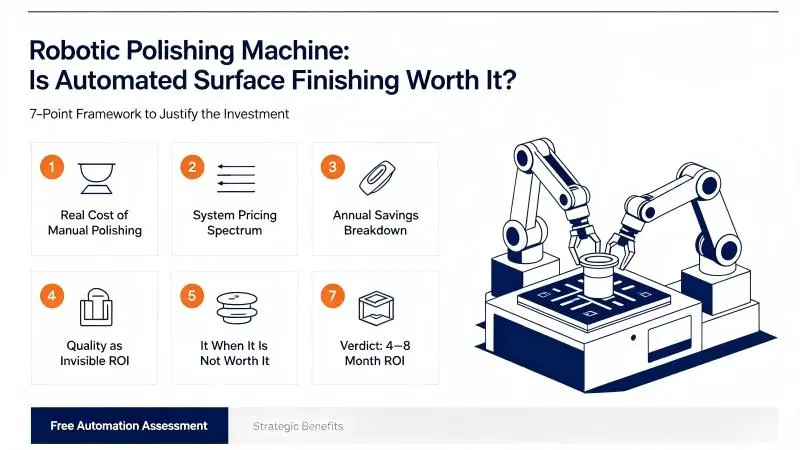
1. The Real Cost of Manual Polishing
Before evaluating automation, it is essential to understand the true cost of manual finishing. Many factories only calculate direct labor wages, ignoring hidden costs that quietly erode profitability.
- Labor shortages: Skilled polishers are increasingly hard to find and retain, especially in developed markets
- Inconsistent quality: Manual polishing produces variable surface finishes, leading to higher rejection rates (typically 5–15%)
- Health & safety risks: Long-term exposure to metal dust and vibration causes occupational diseases, increasing insurance and compensation costs
- Low throughput: A single manual polisher processes 30–50 faucet bodies per shift; a robotic cell handles 3–5× that volume
- Scrap & rework costs: Inconsistent finishing often requires rework, adding 10–20% to total production cost
When all these factors are accounted for, the fully loaded cost of manual polishing typically ranges from $18,000 to $30,000 per worker per year in emerging markets, and $45,000 to $70,000 in developed economies.
2. Robotic Polishing Machine Pricing Spectrum
Robotic polishing systems vary widely in price based on configuration, payload, software capabilities, and ancillary equipment. Below is a realistic pricing breakdown for industrial-grade systems commonly deployed in the faucet, sanitary ware, and die-casting industries.
| System Type | Typical Cost (USD) | Ideal For | Annual Capacity |
|---|---|---|---|
| Single-arm robot | $35,000–55,000 | Small–mid foundries | 80,000–120,000 pcs |
| Dual-arm robot | $55,000–85,000 | Medium factories | 150,000–250,000 pcs |
| Multi-station line | $85,000–150,000 | Large manufacturers | 300,000–500,000 pcs |
| Custom turnkey system | $120,000–200,000+ | High-volume OEMs | 500,000+ pcs |
3. Building the ROI Case
The most reliable way to evaluate robotic polishing investment is to calculate annual savings against the total cost of ownership. Here is a realistic ROI model based on a mid-size sanitary ware factory installing a dual-arm robotic polishing cell at $70,000.
3.1 Annual Cost Savings Breakdown
| Cost Category | Manual (Annual) | Automated (Annual) |
|---|---|---|
| Direct labor (3 shifts) | $180,000 | $36,000 |
| Scrap & rework losses | $45,000 | $9,000 |
| Quality inspection | $30,000 | $8,000 |
| Worker safety / insurance | $15,000 | $3,000 |
| Energy & consumables | $25,000 | $35,000 |
| Total Operating Cost | $295,000 | $91,000 |
Annual savings: $295,000 – $91,000 = $204,000 per year. With a $70,000 dual-arm robotic cell, the payback period is approximately 4 months. Even including installation, training, and tooling ($15,000–25,000), full ROI is achieved in under 6 months.
4. Quality: The Invisible ROI
Beyond direct cost savings, robotic polishing delivers qualitative improvements that compound over time:
- Surface finish consistency: Robotic systems achieve Ra 0.2–0.4 µm repeatability, eliminating the ±50% variation typical of manual polishing
- Reduced rework rates: From 10–15% down to under 2%, directly improving on-time delivery metrics
- 24/7 operation: Robotic cells run lights-out with minimal supervision, enabling true three-shift production
- Data traceability: Modern robotic polishing machines log every cycle — pressure, speed, pass count — enabling ISO-compliant quality documentation
5. When Is Robotic Polishing NOT Worth It?
Honest ROI analysis requires examining the counter-arguments. Robotic polishing may not be the right choice when:
- Production volume below 15,000–20,000 parts per year — the system utilization will be too low
- Extremely complex geometries with undercuts and tight internal cavities — these still require manual finishing
- Frequent product changeovers (multiple times per week) — programming time erodes efficiency gains
- Very low labor costs (below $3/hour sustained) — manual finishing may remain economically viable
In these scenarios, a semi-automated solution — such as a robotic arm with manual part loading — may offer a better risk-adjusted return. The key is matching the automation level to the specific production context.
6. Strategic Benefits Beyond ROI
Leading manufacturers adopt robotic polishing not just for cost savings, but for strategic positioning:
- Workforce retention: Replacing hazardous manual jobs with robot-tending roles improves retention and attracts younger talent
- Scalability: Robotic cells can be replicated identically across multiple production lines, enabling rapid capacity expansion
- Brand perception: Customers increasingly audit supplier finishing quality — automated surface finishing signals reliability
- Regulatory compliance: Stricter silica dust and vibration exposure regulations (OSHA, EU directives) favor automation
7. Conclusion: The Verdict
For mid-to-high volume foundries, die-casting plants, and sanitary ware factories, the answer is clear: robotic polishing machines deliver a compelling ROI, often paying for themselves within 4 to 8 months. Beyond cost savings, they improve finish quality, reduce scrap, and future-proof your operation against tightening labor and environmental regulations.
However, the decision must be context-specific. Evaluate your part mix, production volume, and labor costs before committing. A site audit by an experienced automation provider can help determine whether a single-arm cell, dual-arm system, or full multi-station line fits your needs.
Ready to calculate your ROI? Contact DZ Smart Manufacturing for a free automation assessment.
About the Author
Dingren Lai is the General Manager of Xiamen Dingzhu Intelligent Equipment Co., Ltd. A certified Mechanical Engineer with over 20 years of expertise in automated casting and surface finishing (deburring, grinding, and polishing). He holds multiple national invention patents for robotic finishing and low-pressure die-casting systems, empowering global manufacturers in automotive, sanitary ware, and hardware sectors.