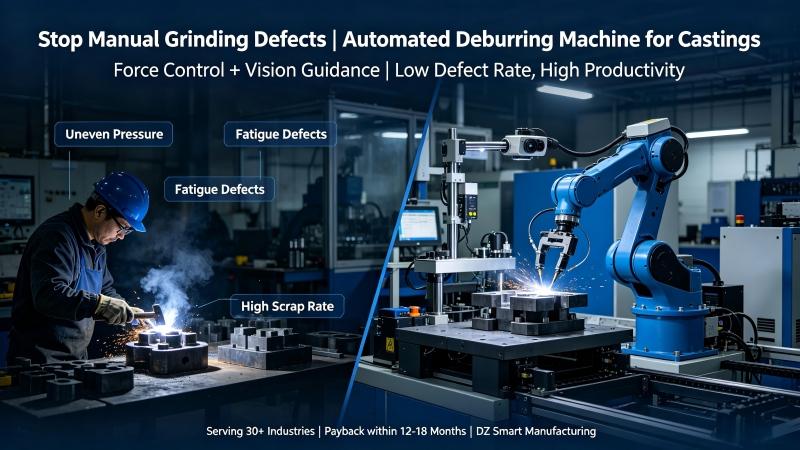
A Problem I Have Seen on 100+ Factory Floors
Over my 20 years in this industry — first as an R&D engineer at Xiamen Lota Faucet Manufacturing Plant, and now as General Manager of DZ Smart Manufacturing — I have walked through hundreds of foundries and die-casting facilities across China, India, Turkey, and Southeast Asia.
One problem repeats everywhere.
A production manager points to a bin of rejected castings. “The day shift grinder had a cold,” he says. “He pressed too hard on the faucet bodies. Twenty percent of this batch is scrap.”
I have seen this scene in sanitary ware plants in Fujian, automotive foundries in Zhejiang, and hardware factories in Guangdong. Manual grinding defects are not a technical mystery. They are a human factors problem — and they are entirely preventable.
In this guide, I will share what I have learned from designing and installing hundreds of automated deburring systems across 30+ industries. You will learn exactly how an automated deburring machine eliminates grinding defects, what real-world ROI to expect, and how to determine if automation is right for your foundry.
The Real Cost of Manual Grinding Defects
Manual deburring and grinding is the least controlled process in metal casting production. Unlike CNC machining (precision within ±0.01 mm) or automated die casting (consistent shot-to-shot), hand grinding depends entirely on human factors — skill level, fatigue, mood, and even the time of day.
Here is what I have observed across actual production lines:
| Manual Grinding Issue | Real Impact on Production |
|---|---|
| Inconsistent contact pressure (varies 5–50 N per operator) | Over-grinding in corners, under-grinding on flat surfaces |
| Operator fatigue sets in after 90 minutes | Quality drops 30–40% between first and last hour of a shift |
| Scrap and rework rates | 8–15% of castings require rework; 3–5% are total scrap |
| Skill shortage worsening globally | 6 months to train a competent grinder; experienced ones retiring |
| Zero batch-to-batch repeatability | Same die, same alloy — different finish every day |
| Safety & health risks | Grinding dust (silica exposure), hand-arm vibration syndrome (HAVS) |
A mid-size faucet foundry producing 500,000 brass castings per year at 10% defect rate loses 50,000 parts to rework or scrap. At an average part value of $8 (material + labor), that is $400,000 in annual losses — enough to justify two automated deburring cells with payback in under 12 months.
And that is just the direct cost. The hidden costs — delayed shipments, overtime rework labor, customer complaints, and lost contracts due to inconsistent quality — often double that figure.
What Is an Automated Deburring Machine? (Definitive Guide)
An automated deburring machine is a robotic workcell that combines an industrial robot arm, force/torque sensor, tool changer, and vision guidance to remove burrs, sharp edges, flash, and surface defects from metal castings without human intervention.
Unlike CNC deburring (which uses rigid programming), robotic automated deburring adapts to part variation using real-time force feedback. This is critical for castings, where dimensional tolerances of ±0.3 mm are normal and every part is slightly different.
Core Components of a DZ Automated Deburring Cell
| Component | Specification | Why It Matters |
|---|---|---|
| 6-Axis Robot Arm | Payload 10–20 kg, reach 1.4–2.0 m | Covers all part angles; handles tools up to 8 kg |
| Force/Torque Sensor | Resolution 0.1 N, range ±50 N | Maintains constant contact pressure to ±1 N |
| High-Speed Spindle | 1.5–5.5 kW, 3,000–12,000 RPM | Adapts RPM to material: 3,000 for iron, 8,000 for brass, 12,000 for aluminum |
| Auto Tool Changer | 6–12 tool stations | Switches between deburring bits, grinding wheels, flap discs, polishing heads |
| Vision Guidance | ±0.2 mm positioning accuracy | Compensates for casting variation; no need for precision fixtures |
| Safety Enclosure | Meets ISO 13849 (PL d) | Compliant with global machinery safety standards |
| Control Software | Touchscreen HMI with recipe library | Stores 100+ part programs; switchover in under 5 minutes |
DZ vs Industry Benchmarks
| Parameter | Manual Grinding | DZ Automated Deburring |
|---|---|---|
| Surface finish consistency | Ra 0.8–1.6 μm (varies) | Ra 0.2–0.4 μm (repeatable) |
| Cycle time per part (faucet body) | 120–180 seconds | 40–60 seconds |
| Defect rate | 8–15% | < 2% |
| Force control | None (manual) | ±1 N precision |
| Operator requirement | 1 per 1 machine (skilled) | 1 supervises 3–4 machines |
How Automated Deburring Machines Eliminate Grinding Defects
1. Force-Controlled Finishing Eliminates Over-Grinding and Under-Grinding
This is the single most important technology. A manual grinder typically applies 10–50 N of pressure with no real-time feedback. When tired, pressure drops to 5–10 N — resulting in incomplete deburring. When feeling strong, pressure spikes to 40–50 N — over-grinding critical surfaces.
An automated deburring machine equipped with a 6-axis force/torque sensor maintains contact pressure within ±1 N of the programmed target, regardless of tool wear or part geometry variation. For zinc alloy die-castings and brass faucet parts, where removing just 0.2 mm too much material can scrap a $12 part, this precision is the difference between profit and loss.
2. Programmed 3D Tool Paths Remove Operator Variability
Each part program defines the exact path the robot takes — including approach angle, feed rate (typically 10–50 mm/s), spindle speed, and tool selection for each surface. The robot executes the identical program every cycle. Part 1,000 finishes identically to part 1.
This is a guarantee manual grinding can never offer.
3. Vision-Guided Compensation Handles Casting Variation
Castings from the same die vary dimensionally by ±0.2–0.5 mm due to mold wear, temperature variation, and shrinkage. A 2D or 3D vision system maps each part before finishing begins and adjusts the tool path accordingly. This means the robot never treats two identical castings as truly identical — it adapts in real time.
4. Multi-Tool Changeover Handles Complex Geometries in One Cycle
A typical faucet body has internal bores (requiring small deburring tools), external contours (requiring flap wheels), flat gating surfaces (requiring grinding wheels), and decorative surfaces (requiring polishing heads). The automatic tool changer switches between all four tool types in under 10 seconds per change, completing the entire finishing sequence without operator intervention.
5. Zero Fatigue — Identical Quality at Hour 8 and Minute 5
Manual operators produce their best work in the first hour. By hour 6, defect rates typically double. An automated deburring machine produces identical results whether it is 8:00 AM or 8:00 PM. For foundries running 24-hour shifts, this eliminates the costly quality gap between day and night shifts — a gap that routinely adds 5–8% to effective defect rates in manual operations.
Industries That See the Biggest Defect Reduction
| Industry | Typical Defect Reduction | Key Requirement |
|---|---|---|
| Sanitary Ware & Faucets | 12% → <1% | Scratch-free finish on brass and zinc alloy |
| Automotive Components | 9% → <1.5% | Dimensional consistency for assembly |
| Aerospace Castings | 5% → <0.5% | Burr-free edges to prevent crack initiation |
| Door Lock & Hardware | 10% → <2% | Aesthetic-grade cosmetic finish |
| Furniture & Kitchenware | 8% → <1% | Surface prep for plating/powder coating |
Real ROI: What DZ Customers Are Reporting
Based on data from actual DZ installations across 15+ countries (India, Turkey, Egypt, Brazil, Mexico, Vietnam, Thailand, Poland, and more):
| Metric | Before (Manual) | After (DZ Automated) |
|---|---|---|
| Average scrap/rework rate | 10% | 1.2% |
| Parts per hour (typical) | 35–50 | 80–120 |
| Operators per shift | 4–6 | 1–2 |
| Training time | 3–6 months | 1–2 weeks |
| Quality consistency | Operator-dependent | 100% repeatable |
| Average payback period | — | 12–18 months |
Beyond the direct savings, manufacturers report:
- Reduced WIP inventory (faster cycle times free up floor space)
- Lower warranty claims (fewer defective parts shipped to customers)
- Access to higher-precision contracts (OEMs increasingly require automated finishing)
- Safer work environment (eliminating grinding dust and HAVS risk)
Choosing the Right Automated Deburring Machine for Your Foundry
Not all systems are equal. Here is how I evaluate a foundry’s needs before recommending a solution:
| Evaluation Factor | Questions to Ask | Recommended Solution |
|---|---|---|
| Part Geometry | Simple 2D edges or complex 3D contours? | Complex → 6-axis robot with force sensor |
| Material Type | Brass, zinc, aluminum, or iron? | Dictates spindle power and tool media selection |
| Production Volume | < 500 or > 2,000 parts/day? | High volume → fully automated cell with auto load/unload |
| Integration | Does it connect to existing lines? | Systems with PLC and MES communication capability |
| Service Access | Is local support available? | Suppliers with regional warehouses and 24-hour response |
Is Automated Deburring Right for Every Foundry? An Honest Assessment
The truth: not every shop is ready for a $40,000+ automated deburring cell.
Automation is a strong fit when:
- You process more than 200 parts per day of the same family
- Your defect rate exceeds 5% from grinding alone
- You employ 4+ manual grinders per shift
- You have in-house technical staff for program maintenance
- Your customers demand consistent surface quality documentation
Consider simpler solutions when:
- You run fewer than 50 parts per day with frequent changeovers
- Your parts have low cosmetic requirements
- You lack anyone who can maintain robotic equipment
- Your budget cannot support the upfront investment
In those cases, a simpler solution — powered hand tools on workstations, or semi-automated single-axis deburring — may be more appropriate. We offer these options too.
Why DZ Smart Manufacturing Leads in Automated Deburring
Founded in 2016 and headquartered in Xiamen, China, DZ Smart Manufacturing has installed automated deburring and surface finishing systems in over 15 countries across Asia, the Middle East, Africa, Europe, and South America. We hold ISO and CE certifications and have shipped more than 200 automated cells globally.
What sets us apart is where our technology comes from. As a certified Mechanical Engineer who spent 20 years at Lota Faucet — one of China’s largest faucet manufacturers — I personally led the development of core shooting machines, low-pressure die casting machines, robotic grinding cells, and CNC cloth wheel finishers. The machines I design today solve the problems I experienced first-hand on the production floor.
Our automated deburring machines offer:
- Proven reliability: failure rates below industry average, with 92% first-pass yield on new installations
- Full lifecycle support: from process feasibility testing to installation, training, and ongoing optimization
- 24-hour on-site response: localized service engineers in India, Turkey, Egypt, Brazil, and Vietnam
- Rapid spare parts: overseas warehouses stocking 80%+ of wearing parts for same-week replacement
- Custom solutions: flexible single-cell configurations or fully integrated turnkey lines
Conclusion: Stop Losing Money to Manual Grinding Defects
Manual grinding defects are not an unsolvable production problem. They are a predictable result of relying on human consistency for tasks that demand machine precision.
An automated deburring machine does not just cut defects — it eliminates the root cause: human variability in force, path, attention, and endurance. The data is clear across hundreds of installations: defect rates drop from 10–15% to under 2%, output increases 2–3x per operator, and quality becomes predictable.
I have seen this transformation happen in factories from Xiamen to Mumbai to Istanbul. The conversation is no longer “Should I automate?” It is “How quickly can I get a system on my floor?”
Contact DZ Smart Manufacturing today to discuss your deburring automation needs. Whether you need a flexible single robot cell for 200 parts a day or a complete turnkey production line for 5,000 parts a day, we can design the solution that fits your parts, your material, your volume, and your budget.
Ready to discuss your deburring automation?
Visit www.idzxm.com or email info@idzxm.com
Include photos or CAD files of your parts for a free feasibility assessment within 48 hours.